
About Me
About Me
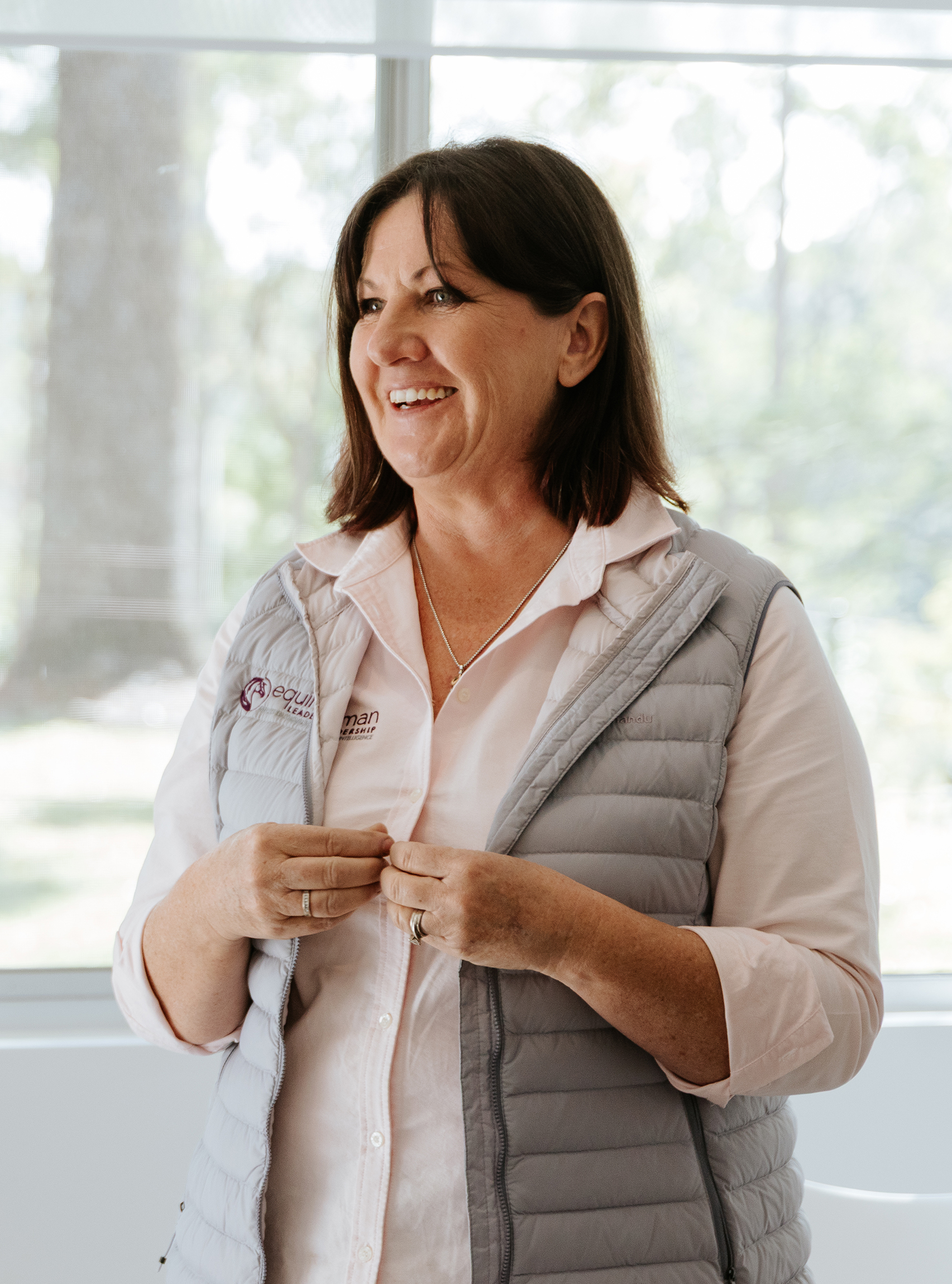
Theresa Hanich
Founder and Facilitator, Equiman Leadership
Author and Developer of the Equiman Congruence Model™
Theresa Hanich is the founder and facilitator of Equiman Leadership and the author and developer of the Equiman Congruence Model™.
Her work draws on more than 30 years of experience across human behaviour, behavioural change, training, education and emotional intelligence development.
Theresa began her career in corporate environments, spending her first decade supporting senior management within the stockbroking and mining industries. Working across complex organisational environments and with people at all levels — from senior executives and political figures to staff and clients — developed her strong awareness of interpersonal dynamics, communication and the subtle non-verbal cues that influence relationships and behaviour.
In 2001, Theresa moved into the automotive and road-safety sector, where she specialised in behavioural-change education. Her work included designing, developing and delivering induction, training, compliance and behavioural-change programs, as well as educational materials for the Certificate IV in Transport and Logistics (Driving Instruction).
She later led the delivery of the national qualification through Blacktown TAFE in NSW and completed behavioural-change and training contracts with organisations including Rotary Youth Driver Awareness, Honda Australia, NRMA, the NSW Roads and Traffic Authority and the Australian Automobile Association. In 2011, she concluded this phase of her career as NSW Coach for the federally funded AAA keys2drive program, supporting and training industry practitioners at a national level.
Alongside this work, Theresa undertook further study in Transformational Life Coaching, Holistic Counselling and Life Care, Mental Health First Aid and community work. Her focus increasingly shifted toward understanding why people can intellectually know what they should do, yet continue to repeat emotional and behavioural patterns that affect their relationships, decisions and responses under pressure.
This question became central to her work in emotional intelligence.
Over the years that followed, Theresa worked with individuals and groups to develop greater self-awareness, emotional regulation, relational awareness and personal responsibility. Her professional experience, formal study and ongoing exploration of human behaviour ultimately contributed to the development of the Equiman Congruence Model™ — the published framework that now underpins Equiman Leadership’s approach to emotional intelligence, regulation, relational feedback and congruence.
Theresa’s return to horses brought another dimension to this work. After undertaking further study in equine bodywork and later formal training in equine-assisted learning, she recognised the unique capacity of horses to make subtle patterns of pressure, regulation, communication, boundaries and relational behaviour visible in real time.
This became the foundation of Equiman Leadership.
Today, Theresa works with individuals, leaders, teams and organisations through practical, experiential emotional intelligence development. Her approach combines structured learning with real-time relational feedback, helping participants recognise how their internal state influences the way they communicate, respond under pressure, hold boundaries and affect the people around them.
Her facilitation style is grounded, relational and direct. She brings warmth and compassion to the work while encouraging personal responsibility, honest reflection and practical application.
For Theresa, emotional intelligence is not something to simply understand intellectually. It is something to practise, embody and bring into the way we work, lead and relate to others.
Shaped by Horses
Horses have been among my greatest teachers. They’ve taught me that honesty is not an idea; it is felt in the body. They’ve shown me that presence is not performance but a state that can be sensed. They continue to remind me that strength is different from force and softness doesn’t mean weakness.
The herd continues to teach me about relationship, responsibility, stillness, power, trust and the discipline of becoming more honest within myself. I remain deeply grateful for their enduring leadership.
The ECM™ in Practice
The Equiman Congruence Model™ now provides the published framework behind Equiman Leadership’s work but for me, it’s also a daily practice.
I pay attention to what is happening in my body. I notice pressure, resistance, emotion, judgement, control, avoidance and disconnection. I listen for the places where my behaviour may no longer reflect what is true internally.
This practice isn’t about perfection. It’s about responsibility, accountability and becoming willing to pause, reflect, repair, realign and return to a more honest relationship with myself and others.
I’m not interested in helping people perform emotional intelligence. I’m interested in helping them recognise what is actually happening within them, how it’s being expressed outwardly and what becomes possible when they meet themselves with greater honesty, steadiness and compassion.
My Way of Facilitating
My facilitation style is grounded, relational and direct.
I hold space with warmth without avoiding truth. I bring compassion without rescuing and I support people gently as they build the capacity to see themselves more clearly.
People often describe feeling safe, seen and heard with me because they don’t feel the need to perform or become someone else. I meet people as they are, paying attention to what is spoken and what remains unspoken, while respecting the uniqueness of each person’s experience.
At the same time, this work is not passive. It asks for participation, self-honesty and a willingness to notice patterns that may have been hidden, protected or normalised for a long time.
Together with the horses, I support people to notice how they respond under pressure, how they hold boundaries, how they communicate, where they disconnect from themselves and where a more congruent way of being can begin to emerge. The aim is to create the conditions in which they can meet themselves more honestly, regulate more deeply and begin to live with greater internal and relational alignment.
For me, the greatest privilege is witnessing the moment someone begins to embody what is true for them more deeply and step forward with greater clarity and self-belief.