
Many people understand their patterns long before they’re able to change them.
A person may know they avoid conflict but still shut down when tension appears. A leader may know listening matters but still take over the room when under pressure. A team member may recognise they become defensive but still react when feedback feels uncomfortable.
All of this is common.
The problem is not that insight has no value. Insight matters. It helps people name what is happening and begin to understand themselves more clearly but insight alone is often not enough to reorganise behaviour.
Knowing something is not the same as being able to embody it.
Behaviour is not shaped by thinking alone. It is shaped by the body, the nervous system, emotional memory, protective patterns, relational habits, identity, fear, past experience and the immediate feedback people receive from others.
For behaviour to change in a meaningful and sustained way, people need more than information. They need direct contact with how they are actually showing up.
Under pressure, most people don’t respond from their calmest or clearest self. They respond from the pattern they have practised the most.
That pattern may be control, avoidance, people-pleasing, defensiveness, over-explaining, shutting down or trying to keep everyone happy.
Often, these patterns began for a reason. They may have helped a person stay safe, avoid conflict, gain approval, protect themselves from shame or keep some sense of control, but a pattern that once helped us can later hold us back. It can affect how we lead, communicate, make decisions, set boundaries and relate to others.
This is where emotional intelligence needs to become practical.
Emotional intelligence is not just understanding emotions. It’s the ability to notice what is happening inside us, pause before reacting, understand our impact on others and choose a better response in the moment. It’s not only something we know, it’s something we show.
It shows in how we listen, speak, handle feedback, manage conflict, hold boundaries and behave when things do not go our way. One of the most important parts of emotional intelligence is recognising the gap between intention and impact.
A person may intend to be clear but others may feel pressured. A person may intend to be helpful but may actually be taking over. A leader may intend to be calm, but their body language may communicate tension or control. What we mean to communicate is not always what others experience.
That’s why clear feedback matters – not judgement, not criticism, just clear feedback.
Feedback helps us see the difference between what we think we are doing and what we are actually communicating. This can be uncomfortable but discomfort is not always a bad thing. Sometimes discomfort is the moment we begin to see an old pattern clearly.
A person who avoids conflict may feel uncomfortable when invited to speak honestly. A person who relies on control may feel uncomfortable when control no longer works. Someone who seeks approval may feel uncomfortable when setting a boundary.
The aim isn’t to avoid discomfort altogether, it’s to stay present, supported and aware while something important becomes visible. That’s where change begins.
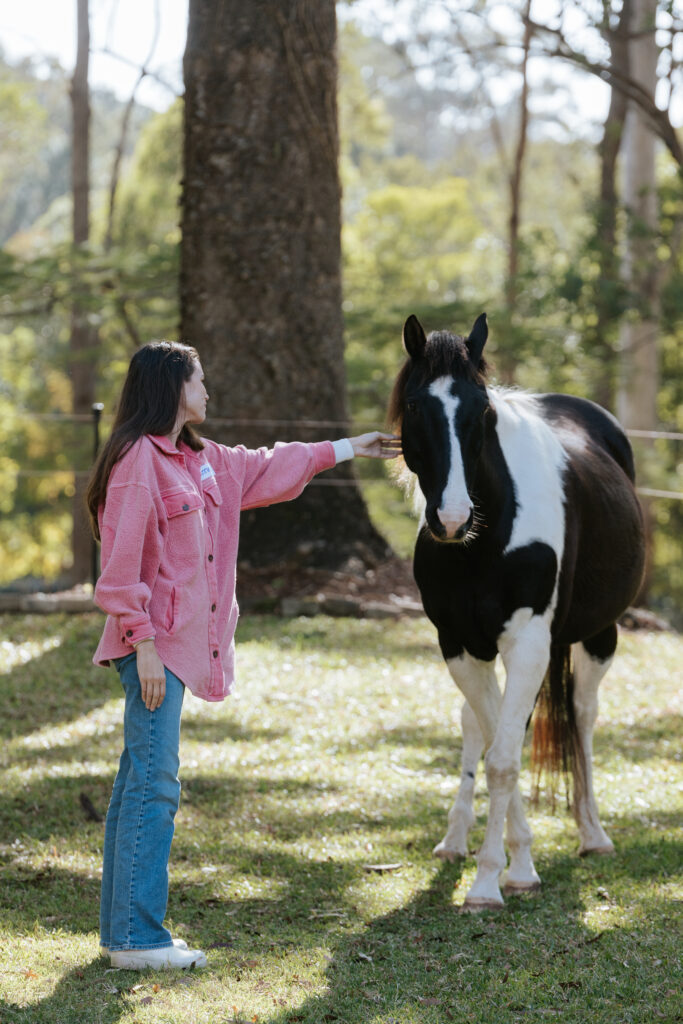
In equine-assisted learning, horses respond to what is happening in the moment. They notice body tension, pressure, hesitation, clarity, movement and intention. They don’t respond to job titles, explanations or how someone sees themselves. They respond to what is actually present in the interaction. This makes the learning very direct.
A person may believe they are calm, but the horse may respond to tension in their body. A person may believe they are clear, but the horse may show hesitation or mixed intention. A person may believe they are being gentle, but the horse may respond to pressure.
This isn’t about judgement or exposing people. It’s about creating a safe and respectful learning space where people can notice what is happening inside themselves and practise a different response.
This is emotional intelligence in action.
It moves learning out of the head and into real life. It helps people see how they respond under pressure, how they affect others and where their behaviour may not match their intention. Most importantly, it gives them the chance to adjust in the moment and that’s what makes the learning powerful.
Real change needs more than awareness. It needs practice, clear feedback and the ability to stay present when discomfort appears. It asks us to notice what is really happening and choose a different response.
That is where emotional intelligence becomes practical – not just as an idea and not as a performance but as a lived ability to become more aware, steady, honest and aligned in how we relate to ourselves and others.
At Equiman Leadership, this is the heart of our work.